All posts by Jon Brady

How Equator Balances Maths, Fun and Hats

Last week we announced Equator, a sum-balancing maths game for two players on a single iPad or Android tablet. Playtest results with schools have so far been positive. Which is good!

Importantly, this means that we can start to tell you about the gameplay – and why it’s proving popular with our little testers. Today’s blog will cover Equator’s basic game mechanics in full, describing how exactly kids work together to create matching sums and this is both beneficial and – crucially – excellent fun.

The game features two farmers at opposing ends of a planet, who must work together to grow and harvest numerically-valued fruit – but they can only so do if their harvests are equally balanced. In other words, they each need to create a maths calculation which results in exactly the same answer. A complete inclusion of BODMAS rules, including tutorials for each element, ensures that every base is covered for kids of all primary school ages!

Equator's maths-balancing in action! (click to enlarge)

Equator’s maths-balancing in action! (click to enlarge)

Playing Equator is simple. Sitting at opposite ends of the tablet, players plant fruit by dragging it from trees into the centre of the planet. Operators such as pluses and minuses hang around in the sky and can be dragged into the middle of the planet and arranged in any order to create calculations. The craft of the game is the creation of matching sums, and matching sums can only be created through communication. Our playtests so far have resulted in a lot of conversation – “I have this, this and this…what do you have?” is a popular line – and we think this is great, as it’s exactly the sort of collaborative gameplay we were hoping to see.

There’s some extra fun too, in the form of hat customisation for our squidgy farmer characters (which can be turned off in class!). We’ll have more on the customisation in the coming weeks, but our immediate priority is introducing Equator’s four seasonal stages and their educational benefits – and we’ll be introducing them to you, right here on the Interface3 blog, very soon.

Read more on Equator: Collaborative Maths Problem Solving for Kids 5+ on iPad and Android!

Subscribe to receive important announcements!

* indicates required

Also subscribe to the more regular newsletter?


Smash-Sums-Feature-1

Smash Party is just one month away! To mark the beginning of this countdown, we’re going to share with you exactly how Smash Party helps kids improve their literacy and numeracy skills through collaborative gameplay with three friends or classmates by breaking down each of the four topics we’ve created for the game. Today, with pictures, it’s a quick rundown of the number-crunching Smash Sums!

As with all other games in Smash Party, kids take turns at asking questions out loud, and all other players must work out the answer and confirm they have it – if they do have it – by pressing their area of the game screen. Originally the core mechanic of I Have, Who Has, we’ve made Smash Sums just one of four mini-games inside this bigger, better title!

Smash Sums in action!

Smash Sums in action! (click to enlarge)

For kids of all ages, Smash Sums can be played on one of four difficulty levels, with randomly selected questions presented in every single game. Starting out with addition, the harder difficulties will go on to cover subtraction, multiplication and division – all whilst retaining the cooperative formula.

Smash Sums is designed to really test a child’s mental arithmetic skills whilst working with peers to beat the game’s rounds, which increase in length with each successful win. But random button-pressing is discouraged, and kids can lose progress in rounds by trying to cheat – so real thinking is encouraged, and required, to win.

Smash Sums is just one of four mini-games featured in Smash Party. We’ll have news on another topic next week!

Read more: Smash Party Will Improve Kids’ Maths and Vocabulary Skills – Here’s How

Read more…

Cosmic Reactor by Interface3

We promise that this will be the final week in a row this happens: but we have another game to announce as in production! We are proud to announce our third multiplayer learning game for iOS and Android: the intergalatic, multi-topic test of skill and reaction times for kids aged 5+ – Cosmic Reactor!

Playing as one of several zany extraterrestrials, kids compete to come out on top across a series of unique reaction tests based around numeracy or literacy. From rearranging numbers through to answering true/false questions, there’s variety across the entire game – and teachers will be able to customise it to suit any particular lesson plan.

Cosmic Reactor will be available as two distinct apps, Words and Numbers: the former featuring vocabulary practice and the latter dealing exclusively with maths. It means we can cram more of each topic into the app, and allows for directed learning in the classroom or at home – so nobody’s sneaking in word games during Maths class!

Planet Select Concept

(click to enlarge)

We’ve created the game, from scratch, for two players on a single tablet device, and it features more of a competitive edge than the collaborative-flavoured games we have already announced. Despite this, we still think it’s a lot of fun, and we feel both can coexist in educational harmony. Both competition and collaboration have their individual plus points, making the app an ideal companion piece to collaborative stablemates Smash Party and Equator.

As with Equator, we’re putting a lot of work into the characterisation of Cosmic Reactor – the funky aliens and their matching home planets will no doubt have favourites picked out by kids, and replay value is guaranteed by the competitive edge the game offers. As an innovation-embracing company, we don’t want to stick to a single successful formula, and Cosmic Reactor allows us to build upon what children have learnt together in a fun interactive app.

Cosmic Reactor will be released on iPad and Android tablets this August. Microsoft PixelSense and SMART Table versions are also in development. Keep your eyes peeled for our character design contest – the winner will have their character featured in the final game!

Download the press release (.doc)

Read more…

Microsoft Surface Tablets

Here’s some news we got REALLY excited about. Last night – or this morning, depending on where you are in the world – Microsoft announced their own line of Windows 8 tablets, which they have entitled Surface. We’re excited about these – so excited, in fact, that we plan on adding Surface support to all apps which we will produce for Microsoft PixelSense tables – the new name for what was formerly known as the original Surface. Our existing PixelSense apps show a lot of promise, and upcoming games like Smash Party and Equator will all be supported by the table – so to have another platform to develop on is, to use a technical term, very exciting.

The Surface tablets are Microsoft branded and are, by themselves, touchscreen devices – but there’s more to them than that. An iPad-style magnetic cover protects the screen but, when rolled out, becomes a full keyboard and trackpad, which is nothing short of impressive. They also come kitted out with 32 or 64GB of internal storage, a microSD card slot and a USB port for connecting pretty much any device you can think of. (What happens if you connect an iPad?)

One thing that is missing from the new Surface, which we’re a little sad about, is PixelSense – the name of the technology inside the table device which has now become the official name of the device itself. PixelSense tech allows the table to recognise up to fifty objects at once (for example, as we recently worked on, whisky bottles) and use this data to create dynamic and interactive content, such as relevant information or YouTube videos. While tablet computers aren’t going to end up acting as tables any time soon, the PixelSense technology did allow for so many inputs to be detected at once with pinpoint accuracy. But, of course, the Surface does have a small screen, relatively speaking, and it does support traditional multitouch and the more powerful “Pro” Surface tablet supports extremely accurate “digital ink” writing and drawing with a dedicated stylus accessory.

But the reason we’re so excited about the Surface tablet is that it gives us another platform to support, and a multitouch-oriented operating system such as Windows 8 is an exciting platform for us to be on. The similiarities between developing for the Surface tablet and PixelSense table mean that we can easily develop for one and the other at the same time, and deliver our educational games and other apps to as wide a range of platforms as possible with the greatest of ease. The tablets are out in the autumn, so that gives us plenty of time to prepare for the release of games in line with the devices hitting the shelves. We think these look pretty cool – a real Windows tablet designed from the ground up for multitouch!

We’d love to hear what you think – comment below, Tweet us, or leave a message on our Facebook wall!

Read more…

Smash Party is shaping up to be a great collaborative game for parties and the classroom, and we’re really pleased with how it’s coming along so far – in fact, it’s so very, very close to completion we can almost taste it! And it tastes of iPad, probably (or Android, we’re not tablet-biased).

With this in mind, we’re going to describe Smash Party‘s gameflow very briefly, and explain why the format works so well when it comes to helping kids practice their maths and literacy skills in a fun but very productive way. From next week, we’ll go into each of the game’s four modes in even more detail too – so that teacher, parent and curious gamer alike will know what to expect.

Smash Party is based on previous game I Have, Who Has, itself based on the oft-used classroom maths game of ‘loop cards’. Loop cards are a printed set of cards linked by numbers and questions, and each child and teacher in the class is given a loop card for the game. The cards feature both a question and an answer, the idea being that every card will have a match. As a result, the game becomes both a group activity and a test of individual arithmetic skill, and I Have captured the same idea on a smaller scale. Smash Party evolves the concept with four unique modes across two subjects:

  • Numbers: Smash Sums & Missing Numbers
  • Words: Missing Letters & Rhyming Words.

No matter the game mode, a typical round of Smash Party unfolds in the same way: four players gather round an iPad or Android device and take turns asking “Who has…” questions. Multiple answers appear in each player’s game area to create greater challenge in lieu of sheer player numbers. Deliberate thinking and collaboration is rewarded with progression onto more challenging stages.

SmashPartyGameflowScreen

(click to enlarge)

I Have, Who Has worked because the formula was flexible, and giving people multiple answers to choose from gave them think about as they worked out the answer to the current question. Smash Party does more than work: it flourishes, expanding to include multiple subjects inside a single app. It’s the natural progression from I Have and we’re really keen on sharing it as soon as possible.

The game’s four brand new modes will be given the feature treatment over the next few weeks. We hope you’ll come back and read about them, and share our excitement of bringing the game out: we’re confident in the game’s ability to educate and to entertain as a group, and hope you’ll take it for a test drive for yourself at the end of July on iOS, Android, SMART Table or Microsoft PixelSense.

Download I Have, Who Has for free on the App Store.

Read more…

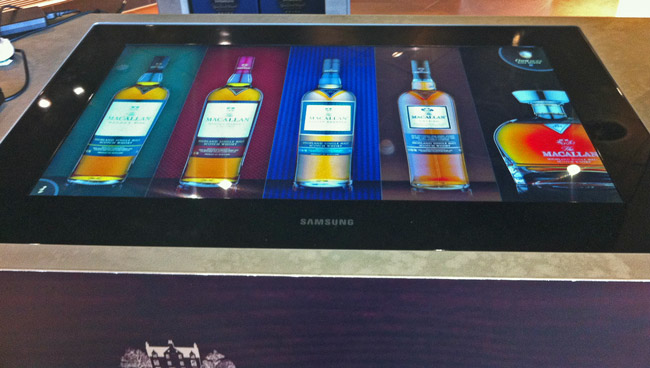
The Macallan Microsoft Surface – The World’s Most Whisky-Friendly Table

Very recently, veteran Interface3 coder Chris Davies popped over to Schiphol Airport in the Netherlands to install a very special table in the Finest Spirits and Cigars store, located in the middle of the travel centre’s bustling shopping area. The table in question is a Microsoft Surface, a huge touchscreen computer designed to be used as a horizontal table – albeit one packed with a lot of amazing and useful gadgetry.

In this case, we were installing a Surface in the casing of a display stand for world-renowned whisky distillery The Macallan, which comissioned us to create an application featuring information, videos and other interactive goodies related to their award-winning, travel-store-exclusive 1824 Collection range of single malts. Now that it’s finished, installed and live, we can talk about it for ourselves!

Thanks to the technology inside the Microsoft Surface 2.0, the application can actually recognise which drink an inquisitive customer has placed on the table and display relevant info directly alongside it, be it tidbits and factoids about the brewing process or relevant YouTube videos. There’s even tasting notes from The Macallan itself, guiding buyers through choosing their ideal whisky – all of this inside a stand with enough room left for the entire 1824 Collection to sit in several times over!

The Macallan Microsoft Surface by Interface3

(click to enlarge)

On-hand information is always useful if a curious buyer wants to find out more about a potential purchase and possibly lead to an informed sale – but this, naturally, is why the installation exists. The Surface and its amazing range of technology allow for a very impressive and richly-presented way of delivering information, and this reflects The Macallan’s brand message of premium quality – and we’re very pleased to have worked on the application on their behalf. You can find the Macallan 1824 Collection Surface stand in the Finest Spirits and Cigars store at Schiphol Airport for the foreseeable future.

We’ve done more work with Microsoft Surface in the past. Check out the Interface3 Apps Portfolio for more.

Read more about our work!

Equator

Another week, another game to announce! Today, in simulataneous development with our other projects, we’re proud to announce Equator, a collaborative maths game for two players. Ideal for playing with friends or in one-to-one lessons in the classroom, Equator will promote everything from the most basic maths use right up to more advanced techniques, catering for kids aged 5 and up.

Testing early versions here at Interface3, even we’ve had some great fun playing this game for ourselves – and we think this is because it’s our most game-like learning app yet. This is because we’ve opted to wrap Equator in a fun backstory and unique art style, turning a maths practice app into a richly presented co-operative videogame.

EQUATORCONCEPT

(Click to enlarge)

Equator is a game which is all about balance – players win by working together to create individual maths equations which have the same answer. No match means no progress, meaning co-operation and communication are essential in order to progress – especially when, say, one player is adding numbers and the other is subtracting them instead!

The concept art featured here should indicate the direction we’re taking Equator in to ensure that it’s not only educational but genuinely appealing, and we have found from play-testing both in the office and at local schools that children and grown-ups alike are happy with the direction we’ve chosen – and they are especially taken with the game characters and their interchangeable hats!

We’re itching to show you more of Equator alongside our other projects, and we’re especially excited about what the game means for us. It’s one of our first steps into creating learning apps with unique and genuine character – and we hope this makes our games especially endearing to one and all.

Equator will be released towards the end of August for iPad and Android. SMART Table and Microsoft Surface versions are also in development. Subscribe to our newsletter for all of the latest news on the game!

Read more…

SMART Notebook Widget - Interface3 Timer Stopwatches

Because producing a great range of educational games for use on iPads and other tablet devices isn’t quite enough, we at Interface3 are big fans of any and all devices which aim to improve the learning experiences of children, inside and outside of the classroom. That’s why we’ve recently been working on some free widgets for the SMART Notebook whiteboard app currently being used by large numbers of teachers in an ever-growing number of schools across the world, and we’re ready to share them with the world.

As in any learning environment, there will be times where kids will have to put the iPads down and take part in class-wide activities, be it group exercises, word jumbles or other independent work. With this in mind, the SMART board widgets we’ve created – which can be downloaded, for free, right now – are simple ideas with simple, but effective execution.

The first of our widgets, available in two styles, is a simple stopwatch and timer for a multitude of uses. The clock can either count up, for the timing of exercises, or count down to zero. It can be set to sound an alarm when time runs out, and can even be set to skip to the next page of a SMART Notebook – ideal for timed class tests!

SMART Notebook Widget - Interface3 WordBreaker

Our second, just-released widget is a “word breaker”, which distributes the letters of an entered word on a SMART Notebook page. The letters can be distributed in order or randomly, making the widget ideal for creating interactive word jumble/anagram exercises.

These three widgets can be downloaded for free right now from the SMART Exchange website, with the only pre-requisite being that a free account is required. SMART Widgets: just another useful teaching tool from Interface3.

If you use any of our widgets in class, let us know! Get in touch, Tweet us or post on our Facebook wall.

Following on from yesterday’s Smash Party announcement, we figured it was worth showing exactly how far the game has come compared to its inspiration. We’ve lined up some early-development screenshots of Smash Party alongside screens from our first ‘loop cards’ game, I Have, Who Has – we’re pretty sure you’ll be able to see just how far we’ve come.

Aside from a tidier user interface and a sharper, clean-cut visual style, Smash Party boasts three new topics alongside the original maths game featured in I Have (FREE on the App Store) – and they focus on practicing literacy and numeracy skills, rather than just the latter alone. We’re going to tell you all about these new modes – and everything else we have planned – in the run up to the game’s release, but for now have a look at these three comparison screens!

Feel free to let us know what you think of how the game looks on Facebook and Twitter.

Please note: these screenshots are taken from a game still in development! They are subject to change.

Smash Party Logo Comparison

(Click to enlarge)

Smash Party Menu Comparison

(Click to enlarge)

Smash Party Gameplay Comparison

(Click to enlarge)

Read more…

Announcing Smash Party!

After a long time spent planning and working away on it, we’re very excited to finally announce a brand new collaborative multiplayer game: the accessible, super-slick and feature-packed Smash Party! We’re looking forward to sharing a lot of new details about the game with you soon, but here’s a rundown of what to expect from the new title when it launches this July for iPad and Android.

Smash Party is inspired by our own game I Have, Who Has, which we released last year. But make no mistake – it’s such a different and expanded game that we’ve seen fit to give it a new name. Almost everything about this four-player game is so fresh, clean, tidy, refined and improved that to list everything would take all day: new menus, new in-game graphics, three brand new game modes, new things to learn, new bonus features, new customisation options…you get the idea.

The game’s eight topics – unveiled over the coming weeks – all revolve around the classic concept of ‘loop cards’: the idea being that players will take turns to read out questions, and one of them will have the answer. Loop cards keep kids on their toes, using their brains to work out the answers to the questions and springing up when their numbers come up. In Smash Party, four players gather around the iPad or Android device, each side representing a player’s quarter of the game board. Players take turns to ask questions out loud, randomly generated to keep gameplay fresh, and the player with the correct answer sitting in their area must answer in order to move everybody onto the next round together. An extra Time Attack mode tasks players to answer as many questions as they can in a limited time, further elevating the challenge!

Smash Party Early Screenshot

An early screen of Smash Party in action!

We believe Smash Party is great fun for use as a learning tool in the classroom and as a party game for kids, because it encourages co-operation and communication in order to succeed, and using these skills effectively reaps the best rewards in the form of new and more challenging rounds. Expanding upon I Have‘s original maths curriculum, Smash Party will have  which require further use of numeracy skills and even literacy skills – stay tuned for more news on those very soon. We want this game to be a fun challenge for kids of ages 5 and up, and will have details of how the game will be adjusted to different age groups closer to the time of release.

We’ll have more details on the game soon, but we hope this has intrigued you a little. If you want an idea of what to expect from Smash Party, you can download I Have, Who Has completely free on the App Store.

Smash Party will be released in late July for iOS and Android!
We are also working on bringing the game to Microsoft Surface and SMART Tables.

Read more…